I’ve seen the future and its made of rubber tube

".............I think there are three real threats to specialty coffee in the world at this time, let me go through them.................."

Today I saw the future and it was made of black rubber tube, a metal frame and plastic sheeting. Sounds very uninspiring, but today I think I saw the future of specialty coffee farming, an option to control one of the biggest threats to coffee, let me explain.

I think there are three real threats to specialty coffee in the world at this time, let me go through them.

1. Commodity speculators

Coffee is something that’s traded in many different ways. The commodity market is the one place where the vast majority of coffee gets bought. Normally this has little to nothing to do with the way we buy coffee, but because of the recent financial issues (economic downturn, stocks and shares being less secure, banks in trouble / low interest rates) this has seen the “commodity price” wander into our playground. I think this issue will be resolved with a little bit of time and the whole world economy improving, we have seen the price drop from its high of $3.05per lb down to $2.60 per lb in the space of a few weeks – a price that I think is far more sustainable for the longer term.

2. World Demand, new world supply

World demand for coffee has been steadily growing for a number of years, while coffee availablity has been fairly consistent. This was because of an over supply of coffee into the market, but this has now been rebalanced. New consuming nations (places like Brazil, India and China all drinking more coffee than they ever have done in the past) means that demand has been growing, but because of the low coffee price the land owner has been less likely to invest in coffee as a product to grow because of lower margins.

This will change with the commodity price of coffee much higher (and I do believe higher prices than the awful sub $1.00 a lb prices of the late 90’s early 00’s will mean that lots more people will plant coffee than they have in the past. The optimist in me thinks that this new chance to plant new coffee may mean that the plant varietal stock they choose may mean that coffee in general improves, but the realist in me thinks it will be yield-led.

I also think that sustained higher prices will quell some of this growing demand, as the cost of a cup of coffee will rise – this is something you can be very sure of.

Either way more coffee will mean that demand can be met for these new consuming nations or higher prices will control the demand and that price will be more balanced in the long term. Another issue fixed and addressed (I reckon).

3. Climate Change

This is a problem that’s a lot harder to sort than the above. It matters not if you agree or disagree with why the world is getting warmer, we live on a planet that is changing and the climate is not the same as it was 10 -20 -30 years ago. Harvest times and yields of farms we have bought from for only a few years have gone through huge changes; we see some places getting hotter, some places having more rain. But one thing that’s consistent is inconsistent weather patterns.

Colombia has suffered more than most. The weather here has become so unpredictable, along with a lot of pest / disease in plants, it’s meant that growing great coffee has become harder.

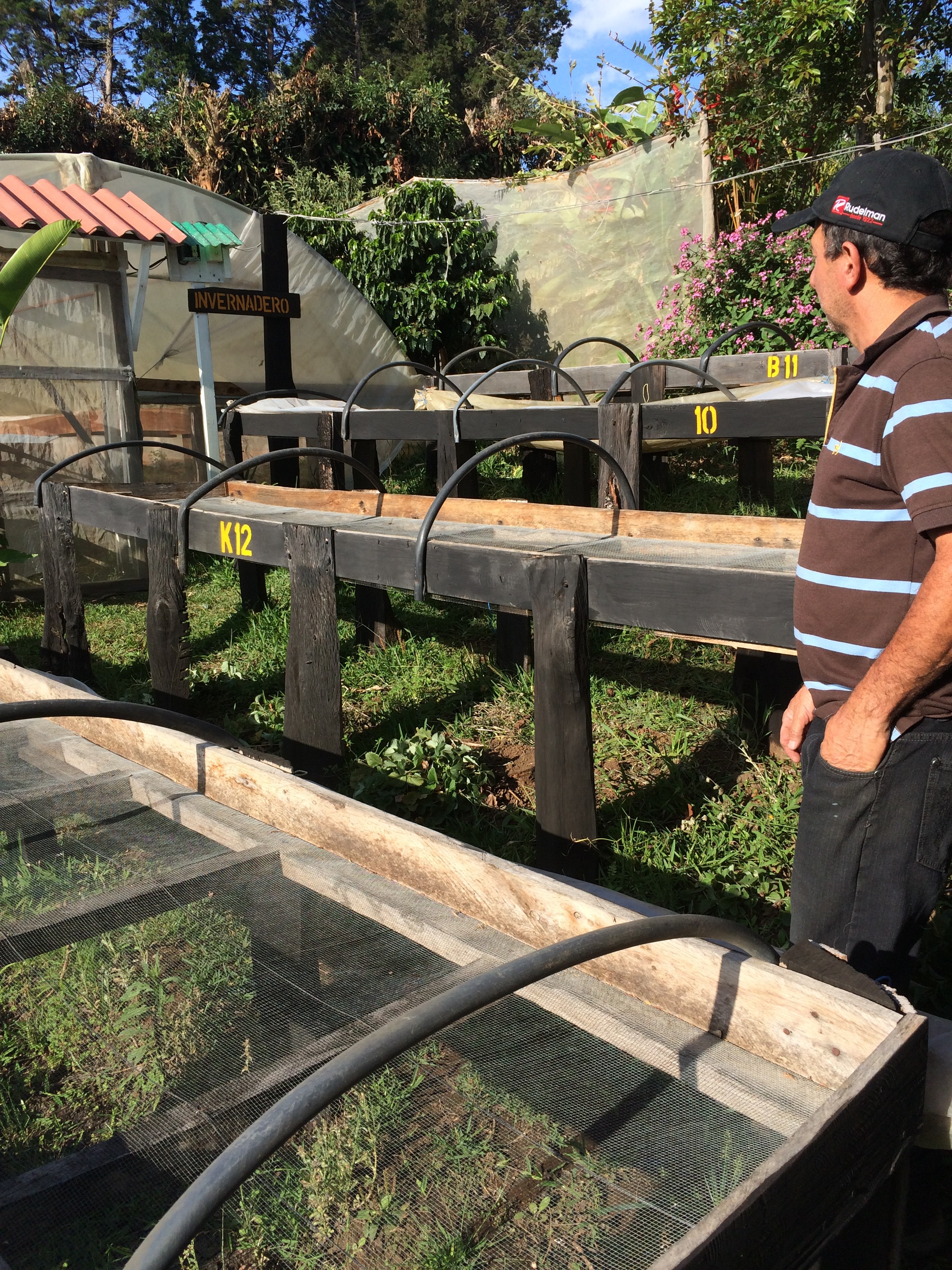
Carmilo from Santurio is working on a new project just outside Cali that is firmly trying to address this. It’s working with irrigation systems to water and to feed nutrients to coffee plants directly through irrigation pipes. Using feed and nutrients through the spraying method means that coffee plants receive around 10% of the feed you put down. Feeding coffee plants through the tube means that 90% of it makes it into the plants. So less nutrients are needed so money is saved. Also by doing it this way it means that the coffee will be ready to produce its first harvest in 2 years rather than the traditional 4 years, so money is again saved. Of course there is an investment in the irrigation technology, but an investment now means it should be repaid fairly quickly.

Irrigation

Irrigation

All this is nothing new; irrigation has been used in many farms successfully, but the killer app is that all this will be done in a greenhouse type building. OK not all: they have three sections to the farm, one part un-irrigated, a test sample of doing nothing if you like, one part un greenhoused but irrigated on a program to suit, as and when needed. And the third is irrigated and in the green house. It’s going to be around 0.3 hector with approximately 1800 plants that produce 3000lb of coffee.

Green House

The reason to put it in a greenhouse is to control the environment. If it gets too hot then you water and open up the sides, if it gets too cold you drop the sides and use the solar energy to heat the greenhouse. Not enough rain – turn on the water. Need to add feed – turn on the nutrients.

I think it’s an exciting and interesting experiment to see if the environment has an impact on the final cup, having the test sample and the irrigated sample makes it twice as interesting.

Carmilo

Carmilo

As you can see by the photos, there are no coffee plants in yet, but this is happening in the next 20 days, so in two years’ time we will see if this works or not.

I’ve seen the future and it’s made of rubber tube.

Rubber Tube

Rubber Tube

VIVA ESPRESSO !!!

"............in London last year I got to meet Frederico and the 2010 champion Alejandro Mendez who I really liked. He was super charming and super talented, and one of the true highlights of the competition for me meeting these two......."

So as many of you know I spent last week on the other side of the world in El Salvador and Costa Rica. Most (nearly all) of the time was spent on farms, and there is lots of info on all that to come soon, but one afternoon was spent in a training room in El Salvador.

The training room was that of viva Espresso, an independent group of shops in San Salvador doing amazing work. I first found their shop on my trip in 2007 and their wonderful owner Frederico Bolaños, and was blown away with the shop. I also got to meet Lili Pacas, who was the champion who would go to Copenhagen for the World Barista Championships in 2008.

Since then I have had fond memories of the shop and the team there. I have since kept a close eye on their exploits and they have held the national title ever since.

In London last year I got to meet Frederico and the 2010 champion Alejandro Mendez who I really liked. He was super charming and super talented, and one of the true highlights of the competition for me was meeting these two.

Because of the wonderful internet, I’ve exchanged tweets and emails with Frederico and it’s great to have friends over the ocean.

So on the Tuesday I was invited to a run through of the three competitors from the shop, for feedback advice and to help them run through the performance.

So the three were Daniel Méndez, Flor de María Góchez (2009 el Salvador Champ and finished 9th in the world championships in Atlanta) and Alejandro Méndez (2010 El Salvador Champion and has made the semis of the world championships finishing 11th overall).

The performances were amazing, like truly amazing. I didn’t have to say this, but I felt all three could have competed on a very high stage, with the sig drinks being amazing.

But there was another reason to be there. Because of meeting Alejandro in London, he asked if I could roast the coffee for him for his national competition. Not because of anything we can do better than them (the quality of roast from both the other guys was amazing) but to show the international reach of great El Salvador, and how coffee has brought new friends to know of what they are doing in San Salvador.

Honoured to be asked to help, I took the coffee in my luggage (we sent some out earlier to make sure he was happy with fedex) and with a blend of Coffees from La Iluison, Alejandro only went and won! So off to Bogata in the World Barista Championships in June.

So proud of the guys asking us to be involved and so pleased that I decided to roast for competition again this year, I would have been gutted to miss out on the feeling I got when I heard that Alejandro had won, that’s very special. Also because of competition I’ve got to make great friends like Frederico.

Viva Espresso

Brazil Fazenda Sao judas Tadeu Picture review

"......a super coffee we hope to see back next year for a third year, we cross our fingers......."

So I got sidetracked by shiny things to the left of me and shiny things to the right of me but I am focused again on getting these photo reviews finished there are some great ones still to come.

This one was in Chapada Diamantina, in the city of Piatã, Bahia, Mr. Antônio Rigno was kind enough to meet us and show us around even though it was a last minute thing. This was not part of the planned trip, but as I found out driving into the middle of Piata you can just find people, Antônio’s house is just around the corner from the shop João Florentino Barbosa from Cerca de Pedra owns, the coffee world is a very small world in Piata.

The farm it self was a model farm, with amazing amenities, beautifully laid out, well looked after and maintained machinery, it was a model farm. Antônio told us this harvest had been even better this year and that they were hopeful that quality would be even higher.

A super coffee we hope to see back next year for a third year, we cross our fingers

OK some some numbers

Farm: Chacara São Judas Tadeu
Farmer: Antonio Rigno De Oliveira
City: Piata
Region: Bahia
Country: Brazil
Farm Size: 35.00 Hectares
Coffee growing area: 15.00 Hectares
Altitude: 1150
Certification: None
Variety: Catuaí
Processing System: Pulped Natural

The Nordic Roaster / Barista Cup

".........I hope it gives you an insight into the coffee world, for the coffee folks I am sure you have heard it before but its my take........"

A bit of a coffee person post coming up, for my customers, I hope it gives you an insight into the coffee world, for the coffee folks I am sure you have heard it before but its my take.

So I spent last week in Oslo participating in the Nordic Roasters cup and the Nordic Barista cup. I’ve been back a few days now, had time to compose my thoughts and thought I would share them here.

To help me to do this I’ve broken it down into the important sections I see this event brings, its such a big topic it will help me focus my mind

1.The people.

This is the biggest and best thing about NBC and NRC. You get a chance to spend time with the great and the good or Scandinavia. Now this is a very broad brush I wave about but there seems to be very little ego from these guys. Small and large roasters brush shoulders, the top baristas share and spend time with the newbies. So many friends but team Norway of Uda and Rasmus and the team gave me the wonderful warm welcome I recvied in Iceland last year. Two people who are amazing baristas and amazing friends (and the team were cool too but these two need special praise)

Tim Wendleboe and Tim Varney were legends, nothing too much and time a plenty, much love to Tim and Tim. The roasting team of solburg and Hansen were too cool for school. Had an amazing moment where one of the guys at Solburg came up to me and told me they got into coffee watching in my mug, and now they are working in coffee. All the team were amazing, nothing too much trouble.

Was great to catch up with Thompson Owen a legend and my hero, the highlight (sorry everyone else but its a special love) he really is one of the nicest guys in coffee, and one of the most knowledgeable. If I understand half he does by the end of my career then I think I will have done ok. Never sure it Tom is pleased to see me or petrified of my craziness. Either way I enjoy chating to him so much.

Everyone is your friend for four days and everyone has time for you, the anti coffee conference an antidote for all the horrors that Cafe Culture can throw at you.

2.The presentations

The presentations I kind of knew what would be interesting from the program, and I knew that some of them were not for me. To listen to George Howell the godfather of the Cup of Excellence is always privilege and someone I would pay good money to listen to.

Tim Wendleboes talk I was not so confident of, but proved to be one of the best, super interesting and put across very very well.

Stephen Vick from the US brought some great experience to the proceedings and again one I was not sure I would enjoy but really did.

But the real highlight was Mr Vince Fedele was stunning, I could have listened for hours but we had just an hour to take in so much information it hurt. My head had more questions that I started with but a sign of a great presentation I think.

So much knowledge shared by such greats, what a week of learning.

3.the social scene

WOW do nords know how to party, I have never seen such desire to party drink. I am known for my desire to party but they beat me every night. The hospitality was second to non. Some great beers great food and great company, this is where the knowledge is shared, and discussions happen.

A great week, great times good friends, good educations sessions and great beers. If only every week was like this :)

Farm Review From Brazil Fazenda Cerca de Pedra

"............The low point of the trip..............."

Another Day another review, not many of these left but I hope you are enjoying them.

if your not tough luck because I am so there.

Farm Name: Brazil Fazenda Cerca de Pedra
Producers Name:João Florentino Barbosa
Region:Piata, Chapada Diamantina
Altitude:1110 to 1200 meters above sea level
Varieties Grown:catura
Last visit: First Visit

Report: This was my fist visit to cerca de pedra, but one I was looking forwards to with great in-trepidation. Located between Divino spirito de santo and sao Judas, it has everything going for it in this hot and up and coming growing region. Being next door to the first second and fifth best farms in Brazil (cup of excellence 2009) certainly gives you a chance.

To find João we drove into the centre of piata and found him, no plans just found him, thats how small the town in (in fact we found him just outside Antônio Rigno’s house). He then had to pop to the supermarket he had recently opened in the town, to get us all water for the long (5 min drive) to his farm.

First we got to see the drying facilities. João doesn’t live on the farm its managed, from this small area. It looked fairly disorganised and not in the best of conditions. A surprise as Michael from Divino espirito de santo had told me how organised it was last year. Once on the farm it was a huge shock. The plants looked distressed, the farm looekd distressed. A case of taking the eye of the ball I think which will cost dearly, the cutting back that was underway means next year there will be nothing from this farm, it was that bad.

I had planned to do an in my mug from the farm, I’d been planning it for three months or so, but I was so shocked by it, I felt it wasn’t appropriate to do so.

The blind cupping table the following day proved out that disappointment. A second cupping Friday also proved equally disappointing.

I think its very sad, but had I been sent these samples without seeing the farm, I would have cried foul after last years amazing cup. But seeing the farm, I could taste my disappointment with every slurp. I hate the fact this may be a one year wonder, but I feel its the right thing to do, let the farm recover and maybe re visit in a couple of years time.

The low point of the trip.

Farm Review from Brazil Fazenda Divino Espírito Santo

".......a rocking farm with a great past and a great future ahead of it, this place is getting better and better on the cupping table......."

Carrying on from the reviews we did before the wonderful aeropress video time to get it back on track here with another update

Welcome to Fazenda Divino Espírito Santo

Farm Name: Brazil Fazenda Divino Espírito Santo
Producers Name:Michel Freitas
Region:Piata Bahia
Altitude:Up to 1300 meters above sea level
Varieties Grown:Obatan, Catuai,Catucai, Acaua, Topazio, Bourbon, Java, Pacamara
Last visit: 1st visit

Report: Owned by Michel Freitas, the farm is located in the region of Piatã, which is in the state of Bahia. At an elevation of 1300 masl (meters above sea level), it has an annual production of around 300 bags but is risking to around 600 next year.

One of my regrets of the last trip to Brazil was not having enough time to go visit Michael’s farm. On that visit he drove three hours to come meet me, and to cup with me. It was clear to me that Michael knew how to cup and could taste coffee and that is always a good sign that the coffee is going to be good. One of the triumphs of last year this coffee was super popular and I was lucky to be able to visit on this trip.

Michael is seen by his peers as a pioneer for quality He seems to know instinctively how he can get the very best out of the land in Bahia. In 2004, Michel won a BSCA (Brazil Speciality Coffee Association) award after finishing 5th and 14th in competitions. He was a 1st place winner in the ABIC (Associacao Brasileira das Industrias de Café) contest in 2006 with a Pulped Natural, and 1st place winner in 2007 with with a Natural lot. He is keen to learn and experiment with the coffees he has, and I think this quality comes through in the cup. He has also ventured into roasting coffee in order to further his learning and develop his skills. Michel is also an accomplished cupper, which is a skill every great farmer should posses. He also placed 8th in the cup of excellence program in 2004

You can see why Michael does so well on this farm. Well organised he is so particular about everything and has a team of people who listen to his every command. He is also very influential in the area, a bit of a politician but also very keen to help advise and guide other coffee growers to improve their quality and raise prices for everyone not just himself.

One thing that comes from this is Michael does not lack confidence, even with my poor grasp of Portuguese I picked up enough to know he thinks he knows best. Even when we toured his newly installed roaster, he was full of confidence he knew what he was doing.

This can rub some people up the wrong way, and last year I wouldn’t have said we hit it off 100% but his coffee certainly did. And this year I think we did a lot more, I asked loads (and I mean loads) of coffee questions and he lots and lots of roasting questions and I think there was a meeting of minds trying to learn from each other. Also I felt some more trust this year, understandable really.

One thing that can not be doubted is his hospitality, so welcoming into his home, espresso which was good and food that was delightful.

Michael is the most competition minded of the farmers I meet, and we will see his coffee in a cup of excellence at some point again soon, particularly with the pl,ant stock he has. So many experiments going on with Obatan, Catuai,Catucai, Acaua, Topazio, Bourbon, Java, Pacamara

With it still being mid harvest I didn’t get to cup them all but the Natural Topazio was a triumph and a special lot (lot 15) he had put together for us was even better than last years coffee. We will see more when its ready from here with samples being sent.

A rocking farm with a great past and a great future ahead of it, this place is getting better and better on the cupping table.